Alerd Berd: the cat that guards my servers
How “warn me when something goes down” turned into a tool that keeps my apps up to date, cleans up my server, and on the way found out that it was the biggest disk hog itself.
November 2026
Project
Alerd Berd: the cat that guards my servers
Alerd Berd: open source
Technologies Used
Links
Challenge
On 13 September at 1:14 in the morning I sent Claude Code this sentence (in German, typos included): “scaffold a new project with the skill. web only for now. Alerd Board will be a monitoring app. it watches my services and warns me, by email or push on my phone ideally.” That was the entire briefing. At that hour I didn't have more to give.
I run a handful of production apps on my own server with Coolify, among them Schnack, Power PopIt and Unveil Me. Coolify sees whether a container is alive, but not whether the database behind it is reachable or the mail queue is overflowing. Off-the-shelf uptime services ping a URL and say green or red. I wanted my apps to tell me how they are doing themselves, in a format simple enough for an AI agent to implement in an unfamiliar codebase without asking questions.
That nine weeks later the tool would also analyse, test and push package updates, send a report every morning, have a cat as its logo and be open source on GitHub, nobody had planned back then.
Solution
1. Spec first, code second
Before there was a single page, there was the health contract: one route, one JSON object, the only required field is status with ok, degraded or down. Optionally it adds components, metrics with thresholds, the runtime versions of the packages and the commit of the build. The most important rule still sits at the top: an app's self-report can only make its status worse, never prettier. Since Coolify still needs a simple route to tell whether the container is running, the detailed self-report comes as a second, token-protected route next to it. No app has to change anything that already exists.
2. One night, five interfaces
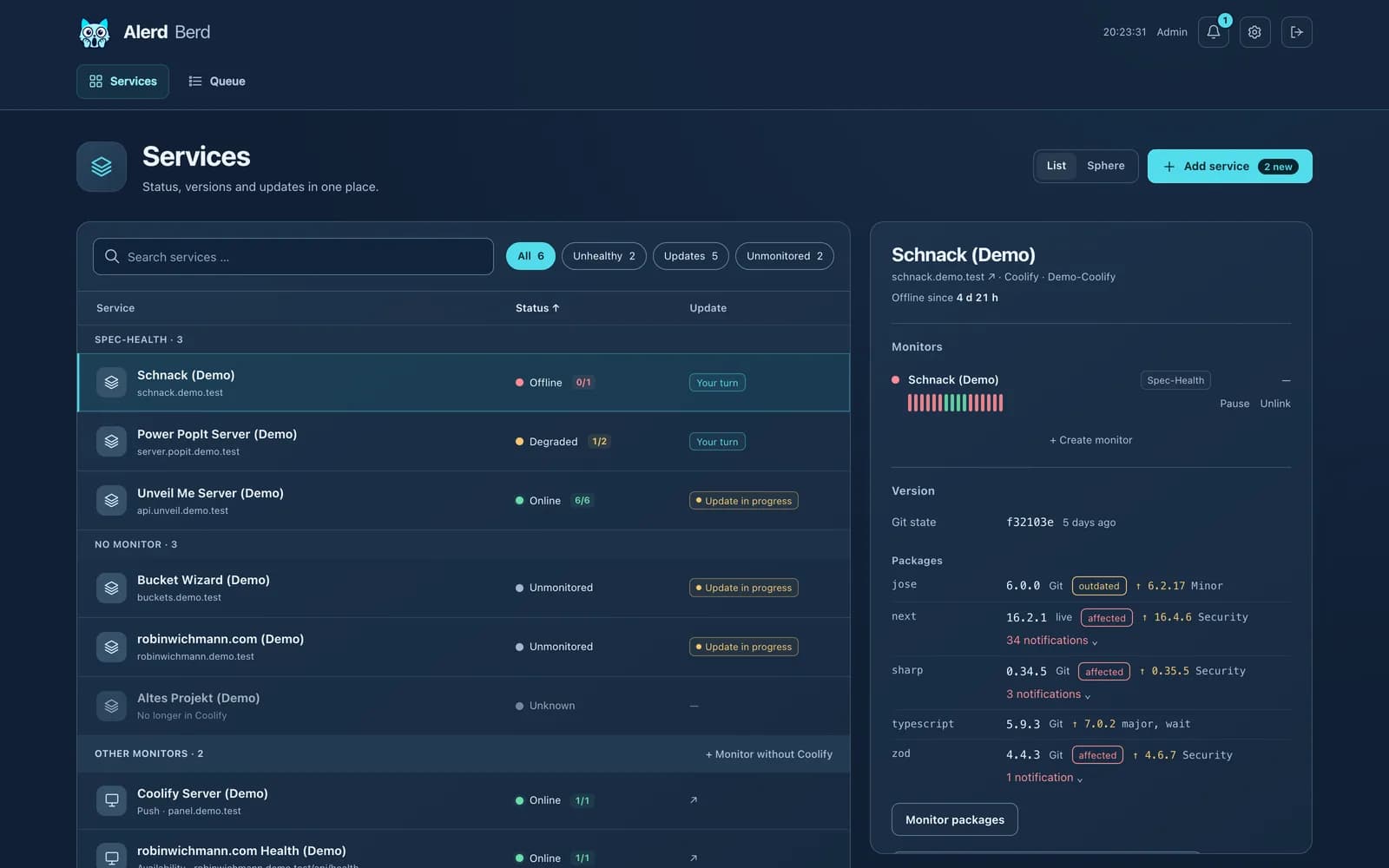
The first interface was an admin tool in a terminal look, and my answer to it: “lol.. THIS is your masterpiece? it looks super cheap. can you do better?” Four more attempts followed that same night, from d3-force through WebGL with HDR bloom to an ECG oscilloscope. What remained is a calm 3D view in which the services pulse as cards on a sphere in time with the checks. Nice to look at, but for daily work I use the list view.
3. Live on day one, in every app
The same evening Alerd was running on my server, with the skeleton including Dockerfile, wiki and release structure coming from my scaffolding skill. Coolify kicks off the checks every minute, so Alerd needs no timer of its own. Right after that Schnack, Power PopIt and my other apps got their health route, one agent and one brief per app. Because every app reports its state in different words, ok, healthy, pass, operational, Alerd translates all the common terms into the three traffic-light colours.
4. From monitor to update tool
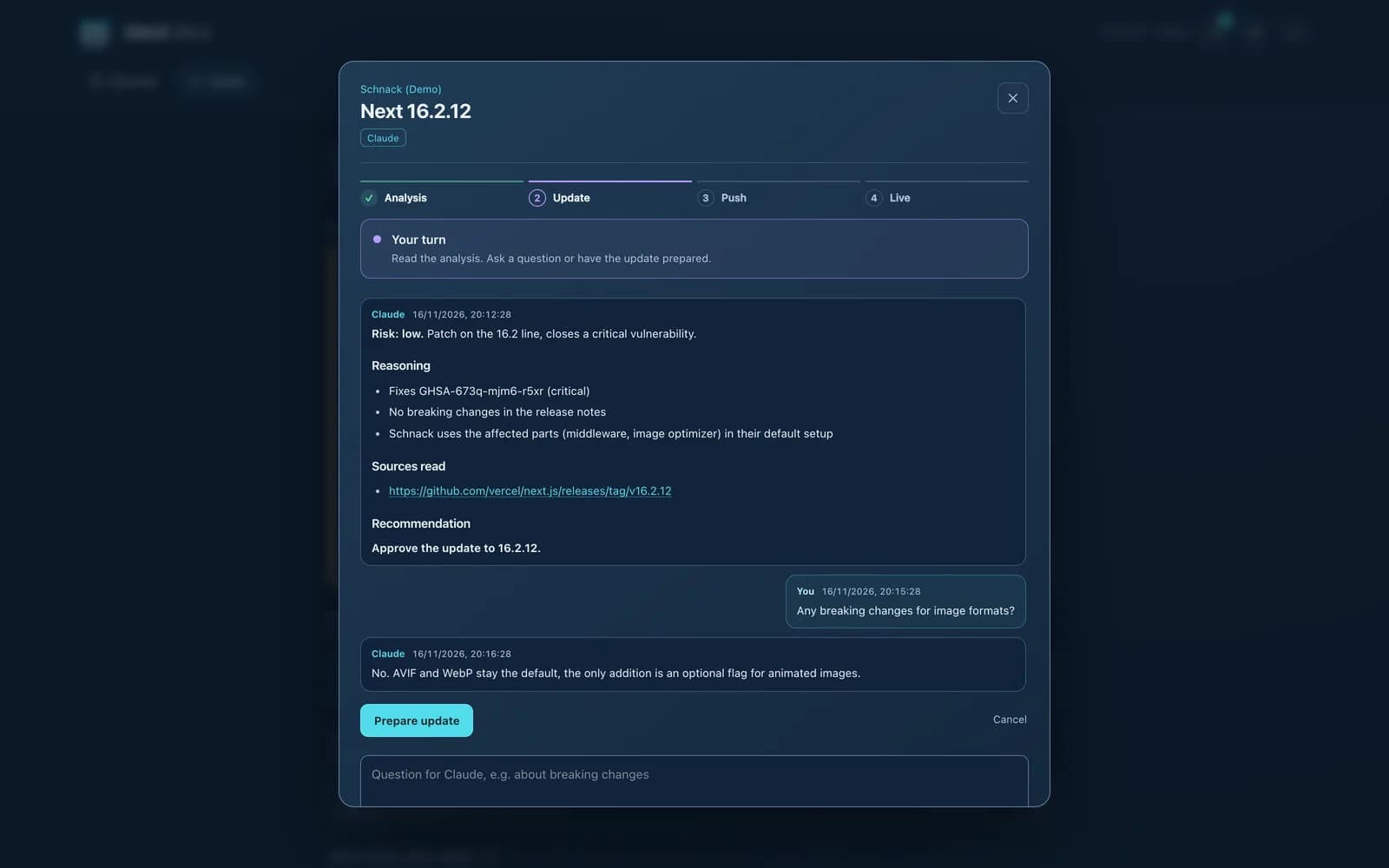
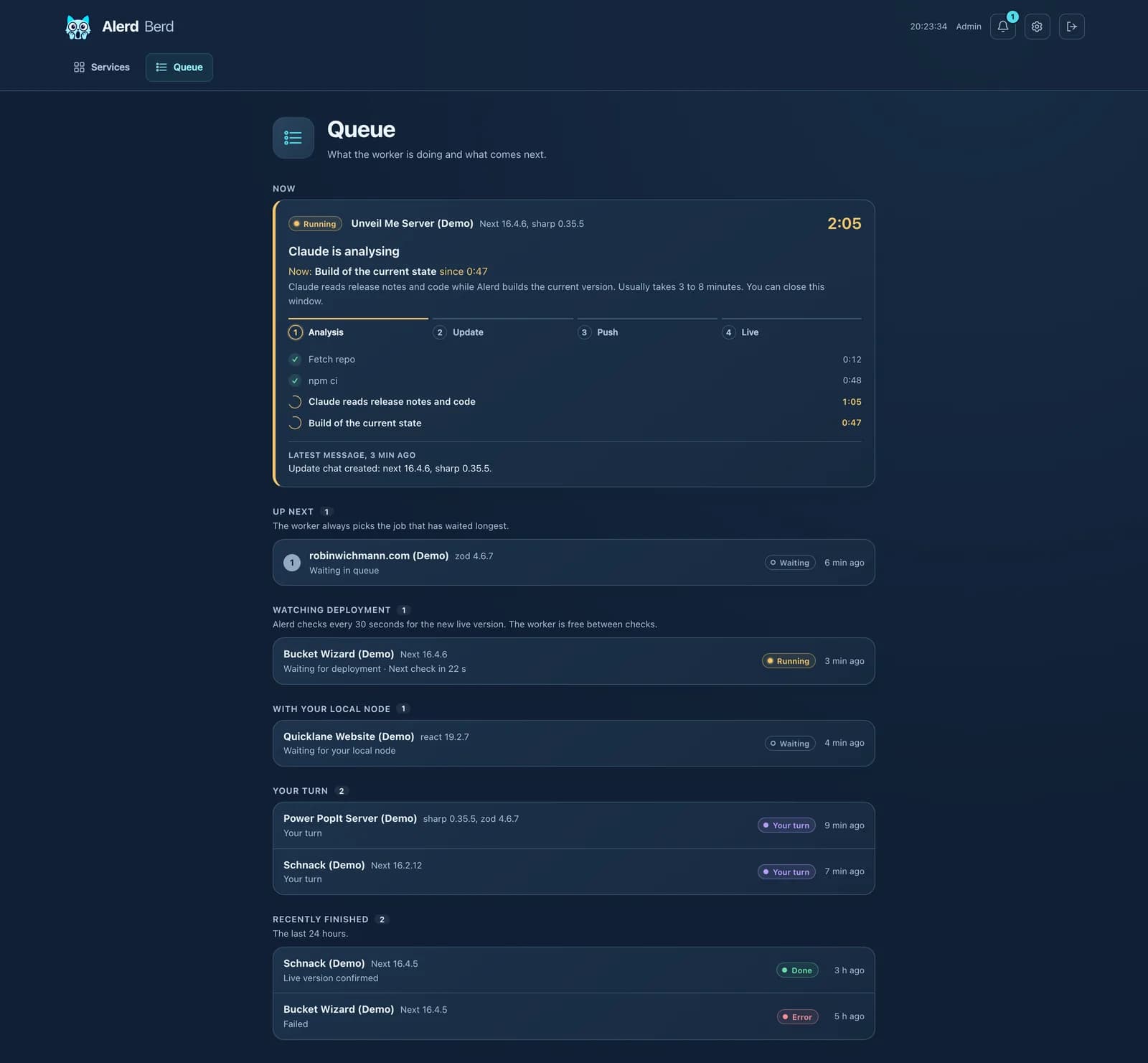
Version 0.3 brought the real leap. Alerd reads the apps and their GitHub repositories from Coolify, compares the package versions in the code with the ones running live, and shows security fixes, recommended updates and known issues per service. That turned into the update chat: Claude Code reads the release notes and the affected places in the repo and assesses the risk. After my approval a worker installs the updates, builds and tests. Only after a second approval is anything pushed, and only if the tested diff is still exactly the same. Coolify deploys, and Alerd uses the commit ID the app reports in its health route to check that exactly this state is live. Nothing happens without me, but I don't type any of it myself anymore.
5. Safely locked down
The worker runs foreign code, npm scripts, builds and an AI agent with read access to the repo. That's why every job runs as its own user that can reach neither the worker's credentials nor the repository that is pushed from later. Tokens are stored encrypted only.
6. Two agents and a local model
Larger, clearly scoped packages went to OpenAI Codex with a written brief, and Claude audited the result. Codex ran into its usage limit twice along the way, and both times Claude took over and finished the job. For the analysis there is now also a local node on my Mac that runs Gemma 4 via MLX. Build and push stay on the server either way.
7. Alerd Berd and the AlerdReperd
In mid-November came the new name, with a message that left no room for negotiation: “Alerd Berd is the new name. And the report is called AlerdReperd.” The report arrives every morning when there are new updates, groups identical updates across all services and advises waiting on big version jumps with a known issue, TypeScript 7 for example, which typescript-eslint couldn't handle yet.
8. Cleaned up, behind itself too
In a single week Next 16.4.6, Node 24 and Prisma 7 went into my production apps through Alerd, repo by repo with a real Docker build before every push. Then Coolify showed that my server's disk had grown from 23 to 74 percent in a month. The trail led to a 51 GB volume, and my reaction was: “oh, that's Alerd?!” The worker had left checkout, node_modules and build behind after every job. Now it cleans up after itself, old measurements get deleted, and Alerd's Docker image is almost half the size. With the same findings the images of the other apps shrank as well.
9. Open source, bilingual
For the release I removed all personal references and built a script that creates a public copy from my private repository, just like I did for the Schnack server. It replaces private values, aborts as soon as names, addresses or credentials would slip through, and tests the copy including a Docker build and the database migrations before I publish it. Since version 0.5 Alerd speaks German and English, right down to the emails and the assistant's answers.
Code Examples
Results
After nine weeks and five releases, Alerd Berd is the tool I start my mornings with: the email tells me what's outdated, the bell what's waiting for my approval, and if something goes down at night, I know before my users do.
- A health format with schema and guide that an AI agent implements in an unfamiliar app without asking
- Updates with analysis, tested changes, two approvals and a check that exactly this state is live
- Server disk down from 74 to 43 percent, Alerd's Docker image from 1.96 to 1.06 GB
- Prisma 7, Next 16.4.6 and Node 24 in all production apps, rolled out through Alerd itself
- Over 1,500 tests, open source under the Elastic License 2.0, in German and English
It started as “warn me when something goes down”, and today it's mostly the tool that makes sure things go down less often.
Insights
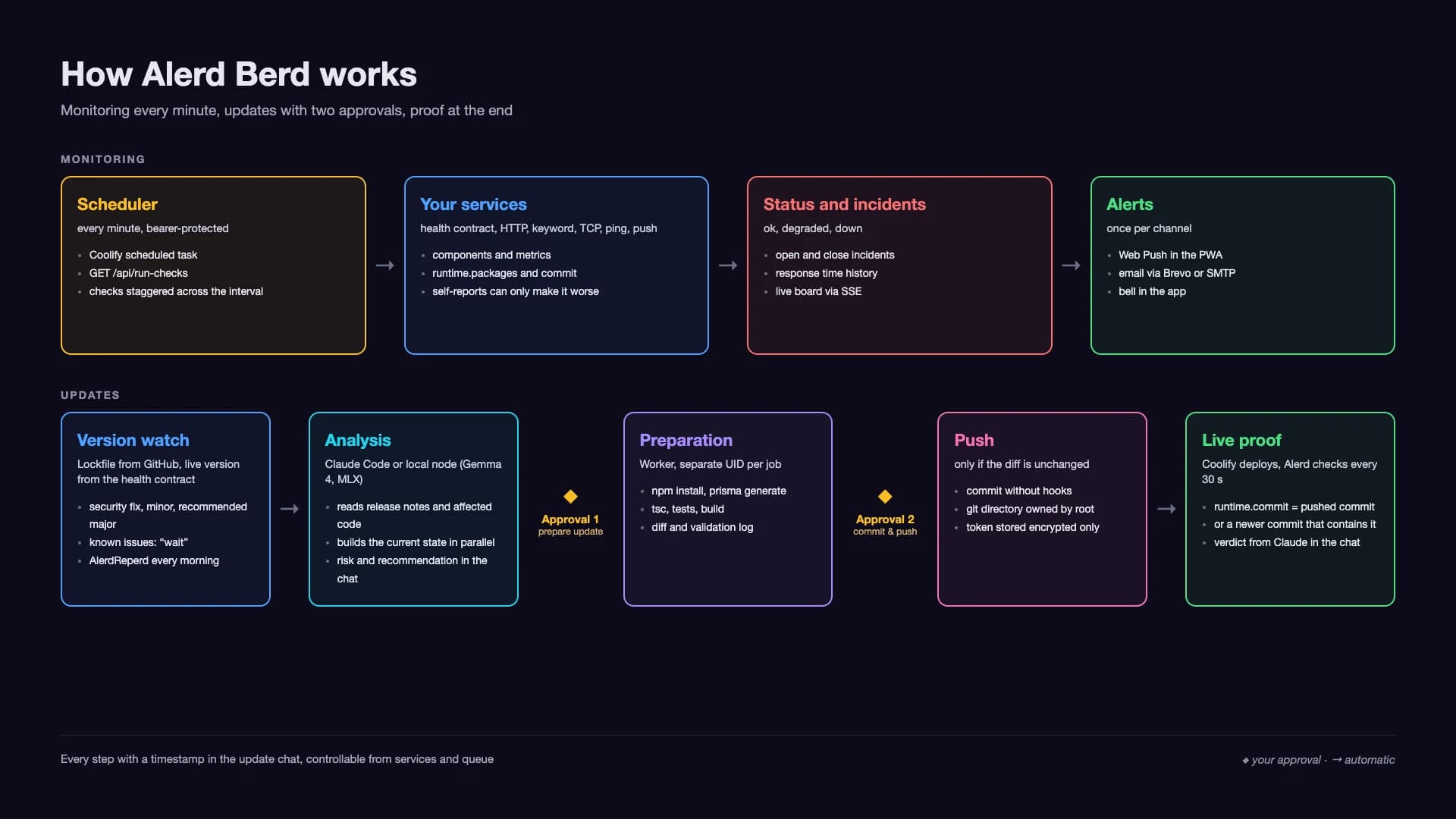
Top: monitoring every minute. Bottom: the path of an update with two approvals up to the live proof.
Comments
No comments yet. Go ahead and start.
Sign in real quick to join the conversation: