Power PopIt: child's play that isn't
Press, pop, let it fly away. A fidget game that parents can hand to their child without having to stand next to them.
November 2026
Project
Power PopIt: child's play that isn't
Technologies Used
Challenge
Every kid knows pop-its: a silicone shape full of bubbles you press until none are left. Most apps built around them are ad spaces with a bit of game attached, full of banners, purchase pressure and rewards designed to make you come back. I wanted to build the opposite: a game that feels like the real toy, is bought once and can then simply be left alone.
That led to two demands that don't make life easy for each other. Popping has to be so direct that there is no noticeable delay between finger and feedback. And the app has to meet Apple's rules for the Kids category, which are rightly among the strictest in the whole store.
Solution
1. A toy, not a slot machine
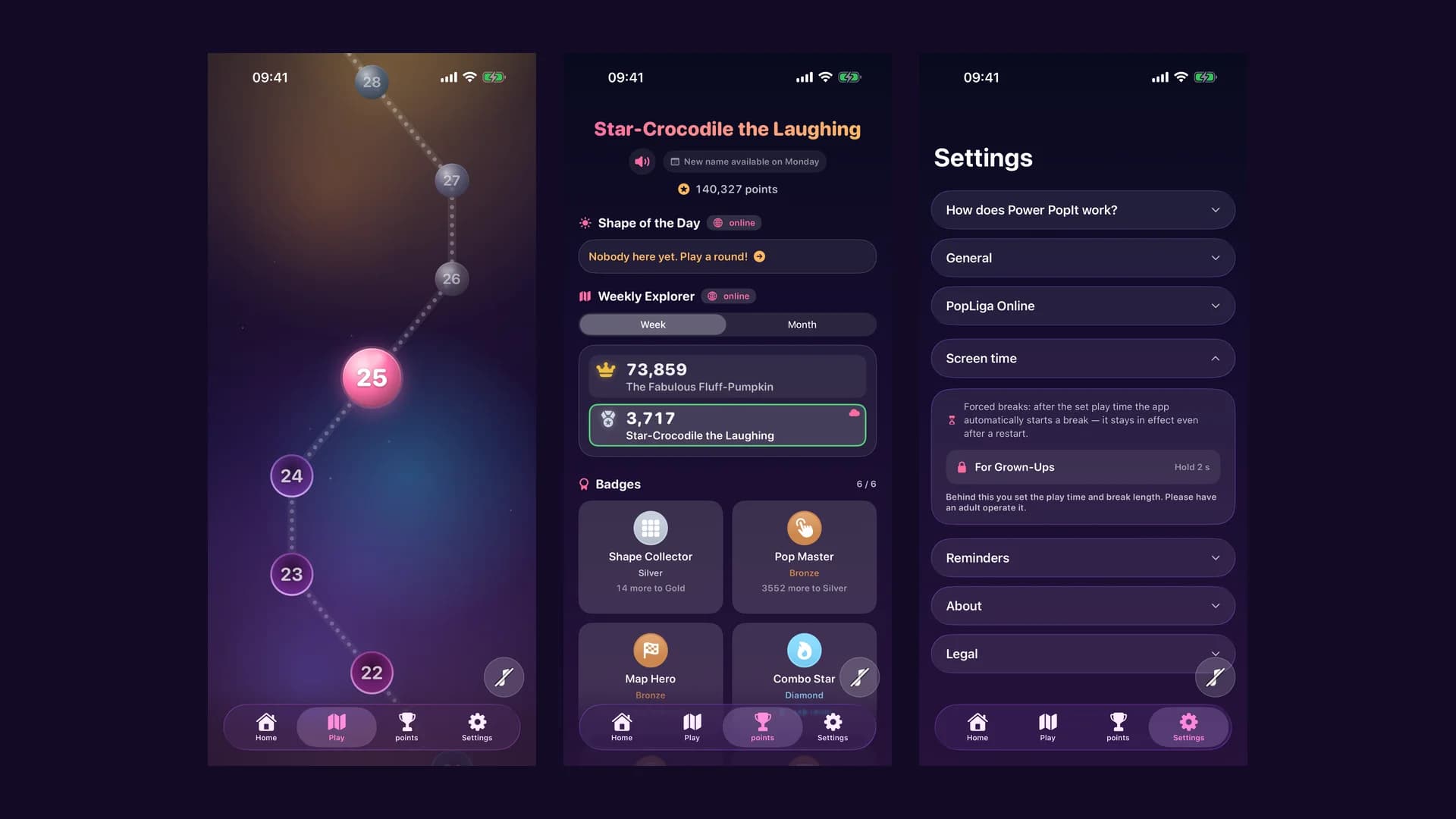
A round has four phases: the shape is assembled from two to four pieces, then popped, with several fingers at once or by swiping. Once the board is empty it flies away and there is a small celebration. There are 83 shapes, from a circle to an elephant, each in three fill levels from coarse to dense. You play freely or through levels on a map that is itself a pop-it. On top of that there is a shape of the day and a weekly explorer, but no timer pushing you and no streak to lose.
2. Made for Kids from day one
Power PopIt is in the Kids category, age group six to eight, and is a one-time purchase. There are no ads, no in-app purchases and no analytics services, offline the app collects nothing at all. There is not a single text field in the whole app: player names are rolled at random, grammatically correct in every language, from over 400,000 combinations. Everything meant for adults sits behind a parental gate that you have to hold for 1.5 seconds before a maths question appears on a custom number pad. That's also where parents set play time and breaks.
3. Online, but only with consent
Anyone who wants to can compete for places on leaderboards in the PopLiga. The league is off by default, switching it on sits behind the parental gate and asks explicitly, before the first upload, what will be sent. There are no accounts, no names and no email addresses, the device identifies itself anonymously via Apple's App Attest. Cheating is hard by design: the app doesn't send a score but the course of the round, and the server recalculates the points itself.
4. The feel is the technology
The game logic lives in its own Swift package without any UI and is fully deterministic: the same input produces a bit-identical shape and puzzle, which makes it easy to test and lets server and app calculate the same points. SceneKit renders the bubbles in 3D with glossy materials, and a custom Metal shader handles the particles when they pop. Touches come straight from UIKit with no gesture recognisers in between, haptics and sound are prepared in advance and play without delay. Over a thousand automated tests hold it all together.
5. 26 languages and an iPad
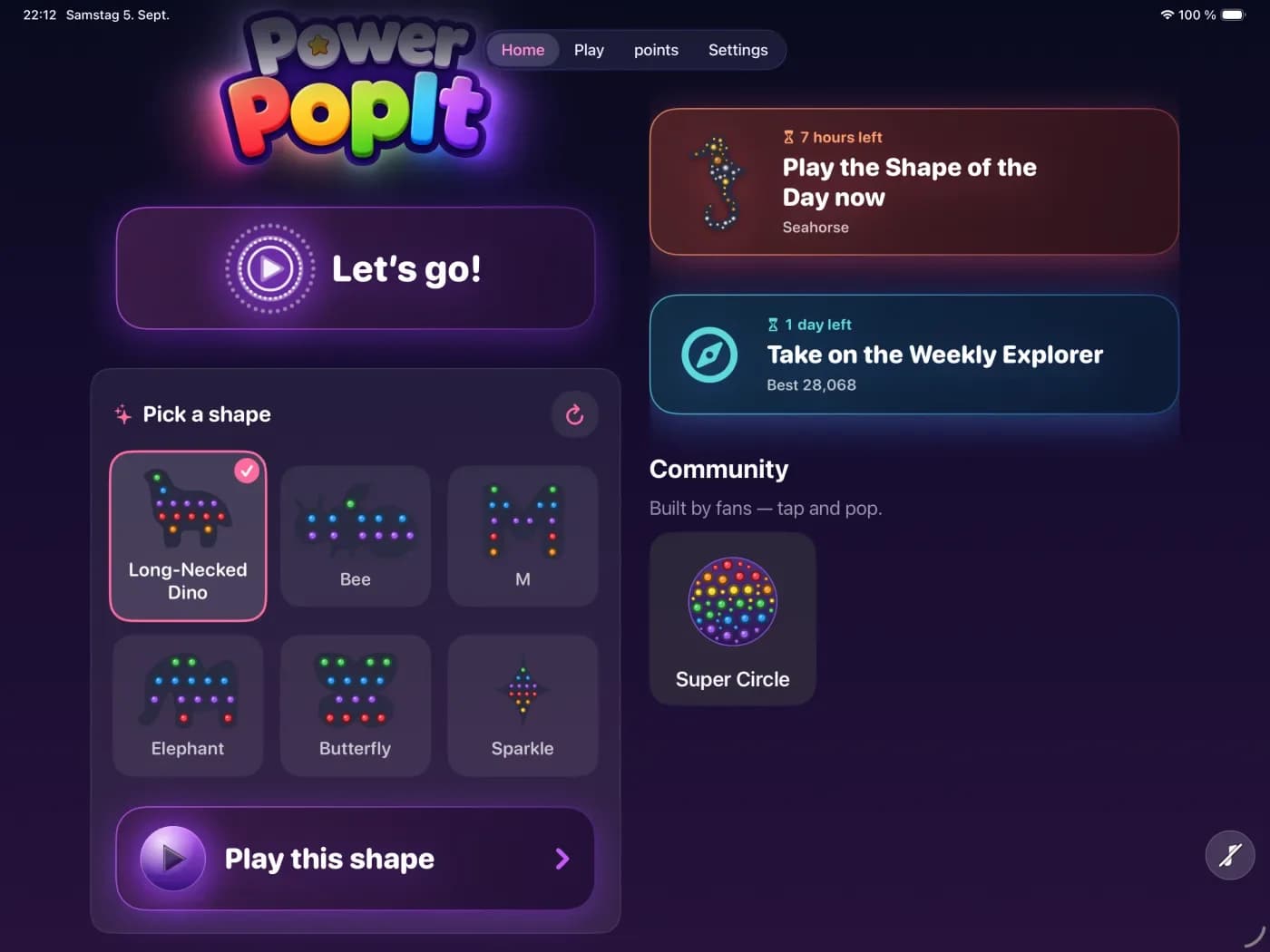
The game, the store listing and the website are available in 26 languages, plus a Swiss German version. On the iPad the app uses the space with its own layouts instead of a scaled-up iPhone. A small server for the league and the website run on my own server with Next.js, Prisma and Postgres.
6. App Review, a lesson
Version 1.0 is live. The update to 1.0.1, on the other hand, has been waiting for approval since September, and every rejection taught me something new about kids apps. First Apple rejected the store description because it mentioned that new shapes also come from fans: in kids apps the text must not promote any way in which content is created, even if every shape is checked by hand. Then the parental gate wouldn't open on the review device, because the hold gesture broke off at the slightest wobble. Finally, explicit consent before the first leaderboard upload was missing. All of it is fixed by now, the decision on the latest build is still pending.
What hurts most is a bug I couldn't see myself. On real devices running iOS 18 the bubbles were invisible after assembly, only the rim and the base remained. It couldn't be reproduced in the simulator, and I had no iOS 18 device. The cause was in SceneKit: the bubbles were re-attached at a moment when their previous parents were being removed, and the GPU of real iOS 18 devices lost their rendering while the simulator's Mac GPU tolerated it. Two fixes only healed the simulator. So I dropped iOS 18 from the supported versions, so that nobody buys an app that doesn't work for them. Except that exactly this change is part of the update still waiting on Apple, and until then the store keeps selling the version that offers iOS 18.
Results
- Live on the App Store for iPhone and iPad, in 26 languages
- Kids category: no ads, no in-app purchases, no analytics services, not a single text field
- Parental gate in front of every adult setting, online league only with explicit consent
- 83 shapes in three fill levels each, generated deterministically, server and app calculate the same points
- Over 1,000 automated tests
Power PopIt is the project where I learned the most about responsibility. Building a game for kids mostly means leaving out lots of things that are otherwise taken for granted, and then patiently explaining why what's left is safe.
Insights
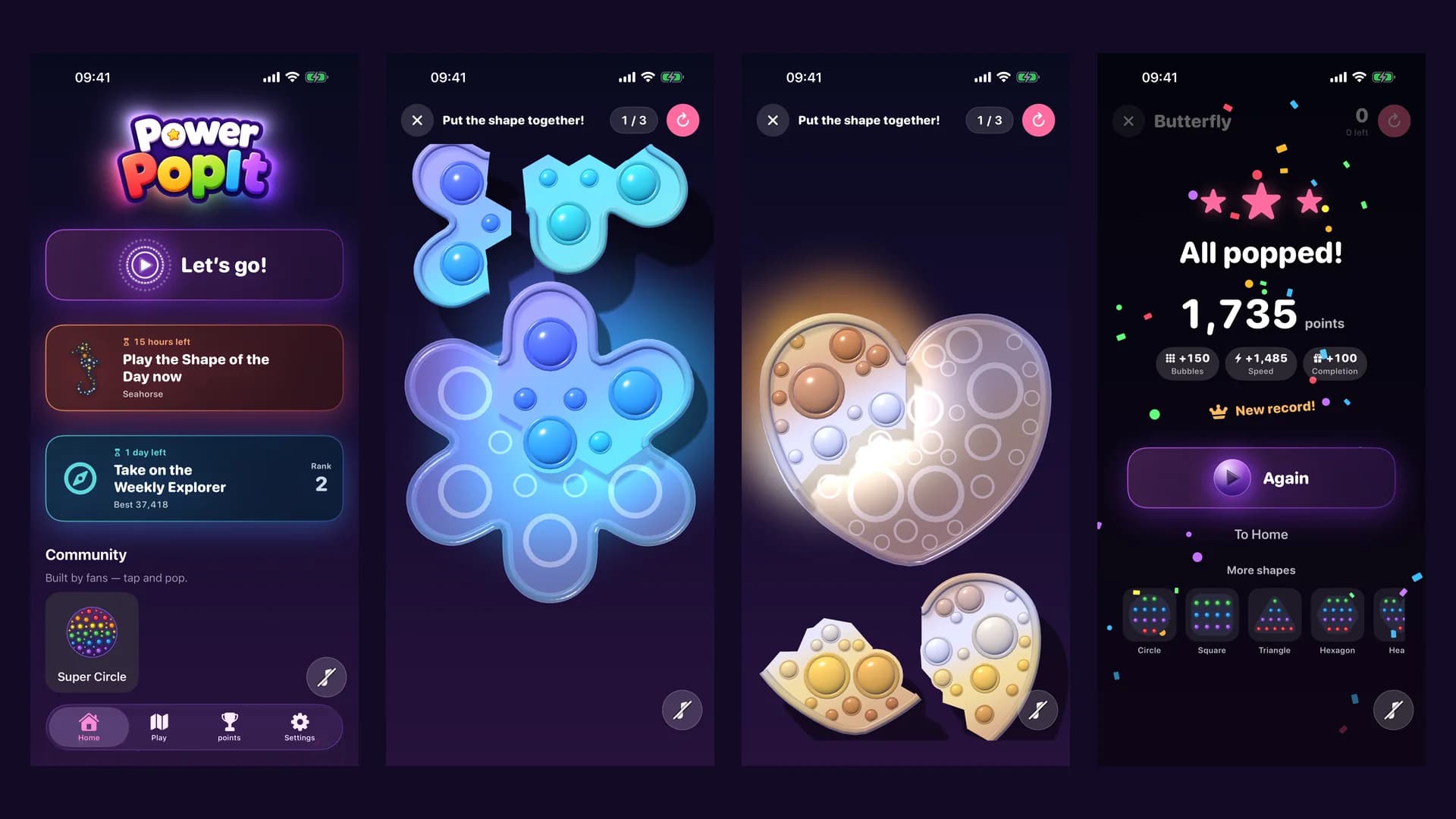
Start, assemble the shape, pop it and the celebration at the end.
Comments
No comments yet. Go ahead and start.
Sign in real quick to join the conversation: